
Tokyo Underground — Tourist Attractions Not Found in Guidebooks, Part 1
Meet the cast 🎙️
This blog is narrated with a little help from my original characters:
Yukko (blue hair) — the curious one who asks what you’re thinking.
Komachi (pink hair) — motivated exclusively by food.
Hide (black hair) — the calm, skeptical one.
Leo (yellow hair) — comic relief with occasional wisdom.
Every guidebook will tell you about Shibuya Crossing. Every travel vlogger has already filmed the owl café and the teamLab museum. That Japan is real, and it’s beautiful. But it’s only half the picture.
This series is about the other half.
I’m not here to trash-talk Japan — I live here, and I love this country. But a culture only becomes interesting when you see its shadows along with its light. A place that’s 100% clean and correct? Honestly, that’s boring. The flaws are where the flavor is.
So let’s start with the most famous “flawed” neighborhood in Japan — maybe on the planet: Kabukicho, Shinjuku, Tokyo.
What Is Kabukicho? The Town Everyone Knows, But Nobody Really Knows
Here’s the thing about Kabukicho: even if you’ve never set foot in Japan, you’ve probably heard the name. It shows up in movies, in video games (hello, Yakuza fans), and in every “Tokyo nightlife” YouTube thumbnail with a red neon filter. For many foreign travelers, Kabukicho sits right next to Times Square on the mental map of famous city districts to see once in your life.
And when you actually visit? Your first impression will probably be… a food street.
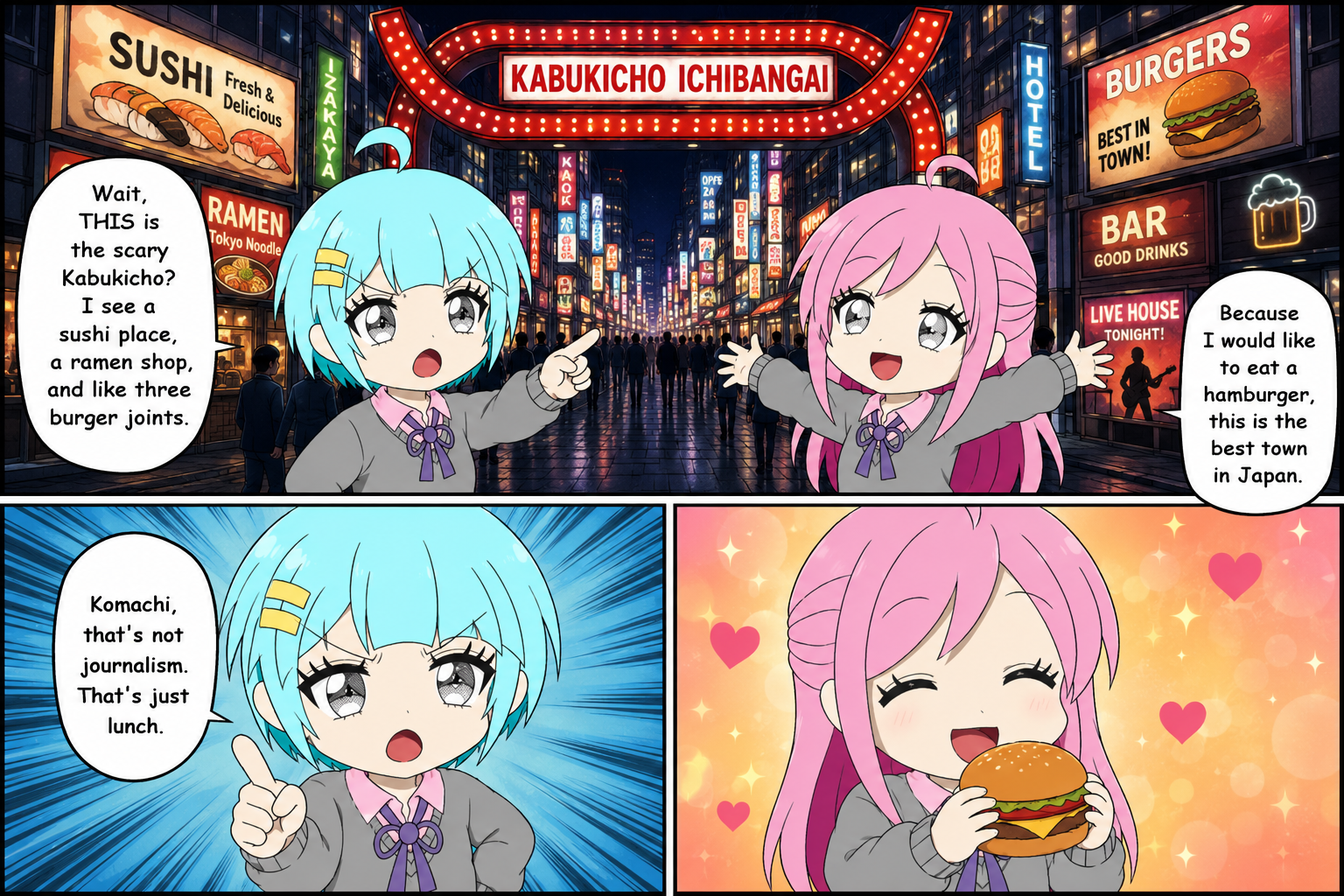
Read this scene as text
Yukko: “Wait, THIS is the scary Kabukicho? I see a sushi place, a ramen shop, and like three burger joints.”
Komachi: “Because I would like to eat a hamburger, this is the best town in Japan.”
Yukko: “Komachi, that’s not journalism. That’s just lunch.”
She’s not wrong, though. By day, Kabukicho is one of the most competitive business districts in Tokyo.
Kabukicho by Day: A Town Where People Burn Their Lives for a Dream
Here’s something most tourists never think about: rent in Kabukicho is brutal. Even the oldest, most beat-up building gets snapped up the moment a unit opens. Why would anyone pay premium rent for a crumbling property?
Because Kabukicho is visibility itself. It might genuinely be one of the most crowded streets on Earth. If your restaurant, bar, or startup can survive here, the world walks past your door every single night.
So during the day, Kabukicho is full of people grinding — chefs prepping before the dinner rush, small business owners doing the math on impossible rent, entrepreneurs betting everything on one shot at the busiest foot traffic in Japan. That’s the daytime face: ordinary people burning their lives to catch a dream.
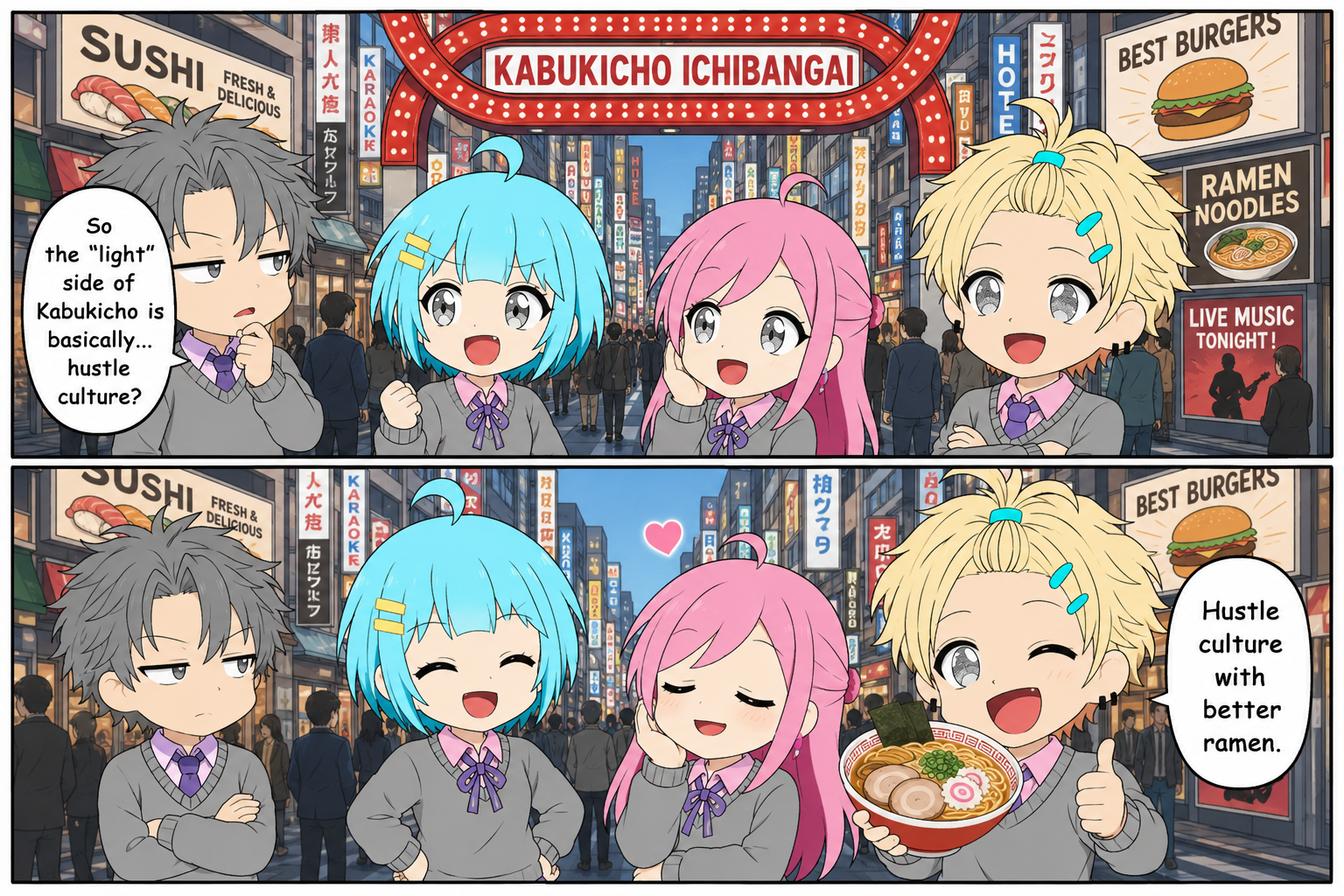
Read this scene as text
Hide: “So the ‘light’ side of Kabukicho is basically… hustle culture?”
Leo: “Hustle culture with better ramen.”
Kabukicho at Night: Host Clubs, Hostess Bars, and the Asterisk
When the sun goes down, the town changes costumes. Host clubs, hostess clubs (kyabakura), girls bars, concept bars. The neon gets louder, the suits get shinier.
And here’s where I want to be very clear, because this is where most Western articles about Tokyo’s nightlife get lazy:
I don’t think this industry is inherently “dark.” Host clubs and kyabakura are businesses. They’re legal, they employ a lot of people, and they’re a genuine part of Japanese nightlife culture. Judging them from the outside with zero context is exactly the kind of shallow take this blog exists to avoid.
What I do consider the shadow side is this:
- Tourist traps and rip-off bars (bottakuri). Some bars will hand a tourist a bill ten times what they expected. If a stranger on the street invites you to a “cheap bar,” that invitation is the product. Walk away.
- The exploitation behind the neon. Not everyone working in this town chose this life from a place of options. Some are trapped by debt, by information gaps, by employers who know exactly how little their staff can push back. The business is legitimate; the way some people inside it get used is not.
That’s the distinction this whole series runs on. “Shadow” doesn’t mean “crime.” Shadow means the gray zone — where people end up with no better choice, and someone else profits from it.
The Deep Shadow: Toyoko Kids and the Line I Won’t Cross
This blog stays neutral on almost everything. Nightlife work, gray-zone hustles, the messy reality of a mega-city — I document, I don’t preach.
But there is one line, and it’s not negotiable.
Around the edges of Kabukicho — in the plaza area known as “Toyoko” — a growing number of runaway teenagers gather. Kids who lost their place at home or school and drifted here, because a famous town that never sleeps looks like freedom when you’re fifteen. And where lost kids gather, adults who exploit them follow: recruitment into shady work, abuse, people who see a runaway not as a child in trouble but as an opportunity.
On this, I am not neutral. The exploitation of minors is not “culture.” It’s not “the shadow side adding flavor.” It is simply wrong, and any honest portrait of Kabukicho has to say so out loud.
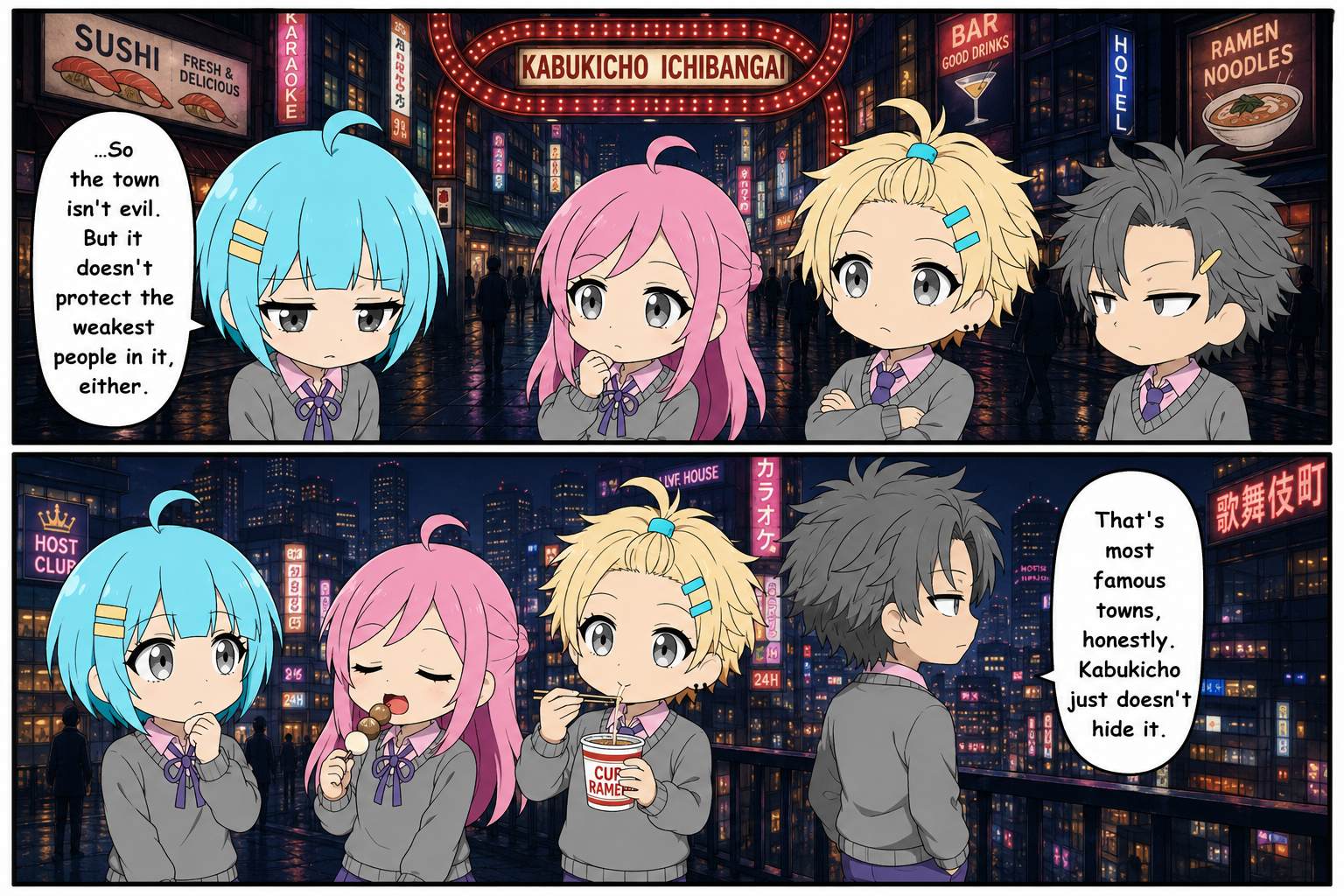
Read this scene as text
Yukko: “…So the town isn’t evil. But it doesn’t protect the weakest people in it, either.”
Hide: “That’s most famous towns, honestly. Kabukicho just doesn’t hide it.”
Is Kabukicho Safe for Tourists?
After all that — should you still visit Kabukicho?
Absolutely yes. Kabukicho is safe enough for tourists if you use basic city sense:
- Don’t follow street touts, no matter how friendly.
- Don’t drink with strangers who approached you first.
- Confirm prices before you order anything.
- Keep your card in your own pocket.
Eat the sushi. Watch the neon. Feel the density of a million ambitions packed into a few square blocks.
Just go with your eyes open. Kabukicho doesn’t lie to you — it shows you everything, the dream-chasers and the predators, the burger joints and the gray zones, all on the same street. That honesty is exactly what makes it one of the most fascinating places in Japan.
The guidebooks give you Japan with the shadows cropped out. This blog gives you the whole photo.
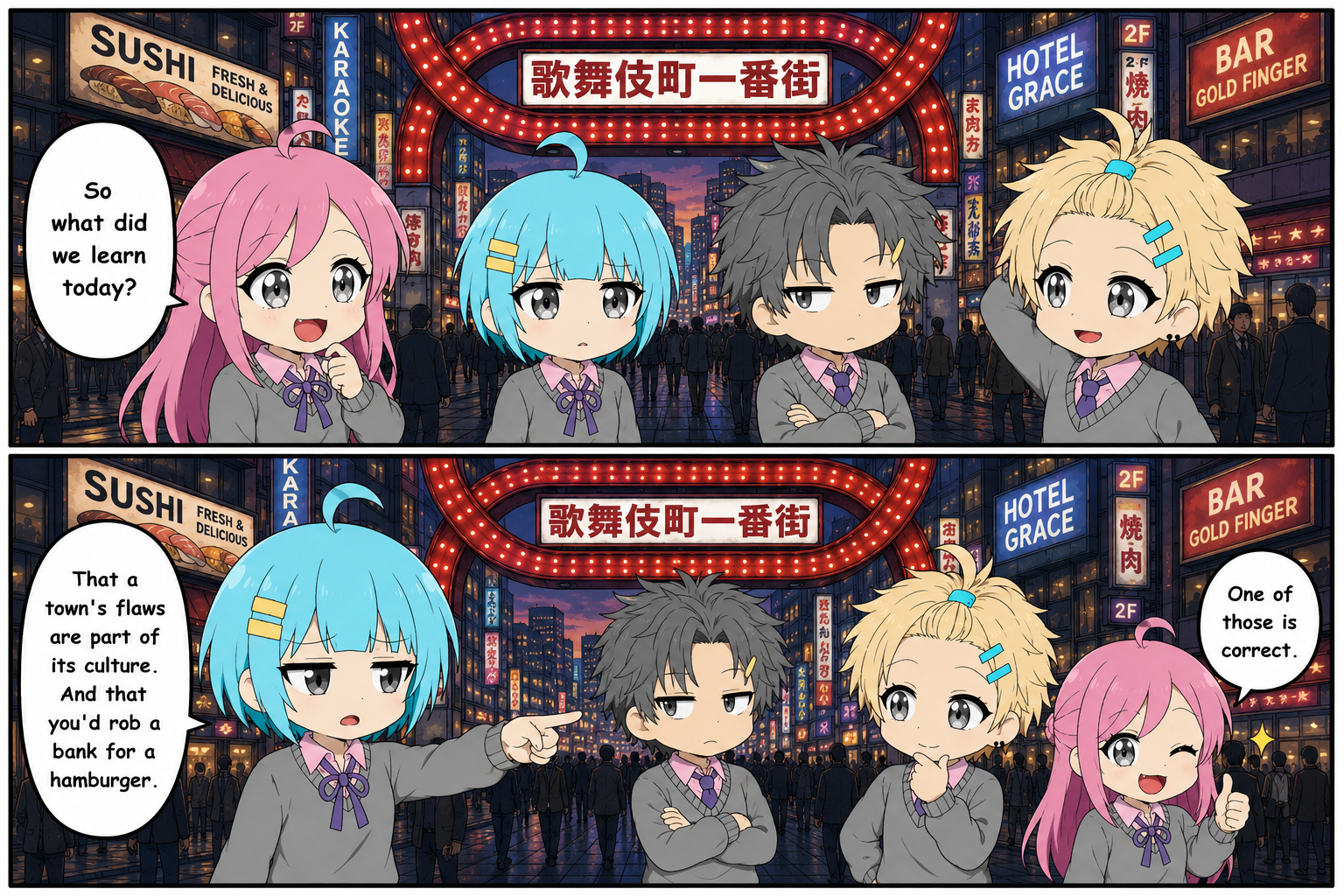
Read this scene as text
Komachi: “So what did we learn today?”
Yukko: “That a town’s flaws are part of its culture. And that you’d rob a bank for a hamburger.”
Komachi: “One of those is correct.”
FAQ: Kabukicho, Tokyo
- Is Kabukicho safe at night?
- Generally yes, for visitors who avoid street touts and unlicensed bars. Violent crime against tourists is rare; overcharging scams are the real risk. Stick to places with posted prices.
- What is Kabukicho famous for?
- It’s Japan’s largest entertainment and nightlife district — restaurants, cinemas, host and hostess clubs, and the Godzilla head on the Toho building. It’s often compared to Times Square in global name recognition.
- What is “Toyoko” in Kabukicho?
- A plaza area near the Toho cinema building where runaway and disconnected teens have been gathering in recent years — a serious social issue in Japan and a symbol of the district’s deeper shadow.
- Is Kabukicho a red-light district?
- Partly. Adult entertainment is one layer of the district, but by day it’s also a normal (and very competitive) business and dining area. It’s far more mixed than the “red-light district” label suggests.
Next in this series: Osaka’s Nishinari — the neighborhood locals tell you to avoid, and why that advice is only half right.
Traveling to Tokyo? [Gear/affiliate section — pocket Wi-Fi, eSIM (Airalo), hotel deals (Agoda), etc.]
Leave a Reply